
Nobody knows your body better than you do. You are the one who notices when something feels a little off, when a spot looks different than it used to, or when the tiredness just will not lift. That everyday awareness is one of the most powerful tools in your health, because most problems are far easier to handle when they are caught early.
This guide is for adults across Luce County and the eastern Upper Peninsula. It walks through the kinds of changes worth paying attention to, what they usually mean, and how to tell when it is time to pick up the phone. The goal is not to worry you. It is to help you feel steady and sure about what to do.
In short: most changes in your body are harmless, and a few are worth a conversation. The trick is knowing your own normal, so you notice when something shifts. When in doubt, a quick call to your provider is always the right move, and catching something early almost always makes it easier to treat.
How do you know what is normal for you?
Your normal is simply how your body usually looks, feels, and works. It is the moles you have always had, your usual energy, your regular bathroom habits, and how you normally breathe and move. There is no single normal that fits everyone, which is exactly why your own baseline matters so much.
The easiest way to know your normal is to pay gentle attention over time, not to inspect yourself with worry. A yearly wellness visit helps too, since it gives your provider a record of what is healthy for you. Our grown-up checkup guide walks through what those visits cover. Once you know your baseline, a real change stands out, and that is the whole point.
A mole or skin spot that changes
Most moles and skin spots are completely harmless, and many people gain new ones throughout life. What matters is not having spots, but noticing when one starts to change. Skin cancer is one of the most treatable cancers when it is found early, with a five-year survival rate above 99 percent for melanoma caught at a local stage (American Cancer Society).
Dermatologists use a simple checklist, the ABCDEs, to spot a mole worth showing a provider.

If a spot checks one of these boxes, it does not mean something is wrong, it just means it is worth a look. Our sun safety guide covers how to protect your skin and check it well. A quick visit can usually settle it in minutes.
A new lump or thickening you can feel
Finding a lump is unsettling, so here is the reassuring truth first: most lumps are not cancer. They are often cysts, swollen glands, or harmless changes in tissue, especially in the breast. Still, a new lump or a thickening that sticks around is worth having checked, because the ones that do matter are far easier to treat early. For breast cancer found at a local stage, the five-year survival rate is 99 percent (American Cancer Society).
Call your provider if you notice a new lump anywhere that does not go away after a few weeks, a lump that is growing, or any change in how an area looks or feels. A provider can examine it, and if needed, our diagnostic imaging team is right here to take a closer look, close to home.
Changes in the bathroom
Your bathroom habits are a surprisingly good window into your health, and small shifts usually mean nothing more than a change in diet, stress, or a passing bug. What is worth a call is a change that sticks around, especially blood where it should not be.
Reach out to your provider if you notice blood in your stool or urine, a lasting change in your bathroom routine, or ongoing discomfort. These often have simple causes. They are also how conditions like colon cancer are caught early, when treatment works best. Colon cancer found at a local stage has a five-year survival rate of about 91 percent, and screening starting at age 45 can catch it before it ever causes symptoms (American Cancer Society). If a screening or follow-up is needed, our surgical services team handles these procedures right here.
Unexplained weight loss or lasting fatigue
These two are easy to brush off, which is exactly why they are worth mentioning. Losing weight without trying, or feeling worn out no matter how much you rest, can have dozens of ordinary explanations, from stress to thyroid changes to a busy stretch of life. Most are very manageable once you know the cause.
The key word is unexplained. If the pounds are coming off and nothing about your routine changed, or the tiredness has hung on for weeks and good sleep does not fix it, bring it up with your provider. A simple conversation, and sometimes a quick round of lab work, can often sort out what is going on and get you feeling like yourself again.
A cough or shortness of breath that lingers
Most coughs are just your body clearing out a cold, and they fade within a couple of weeks. A cough becomes worth a closer look when it overstays its welcome or comes with trouble breathing.
Give your provider a call if a cough lasts more than two to three weeks, if you are short of breath doing things that never used to wind you, or if you are wheezing or bringing up blood. Many causes are very treatable, from asthma to allergies to a lingering infection, and our asthma and allergy care team can help you breathe easier. Catching a breathing issue early keeps a small problem from becoming a bigger one.
When to watch, when to call, when to go now
With any change, the real question is how urgent it is. Here is a simple way to sort it out. When you are unsure, it is always okay to call and ask.
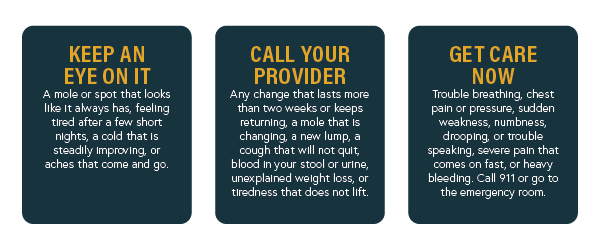
This is a general guide, not a diagnosis, and you know your body best. If something feels wrong, trust that feeling and reach out. We would always rather hear from you early.
How do you bring it up at your visit?
Many people put off a visit because they do not want to make a fuss or waste anyone’s time. Please do not. Your provider wants to hear about the small stuff, and describing a change clearly helps them help you.
A few things make the conversation easier:
- Note when the change started and whether it is getting better, worse, or staying the same
- Mention anything that makes it better or worse
- Write down your questions ahead of time, so you do not forget them in the moment
- Bring a list of your medicines and any family health history that feels relevant
There are no silly questions here. Bringing something up early is exactly what we are here for.
Questions Worth Asking Yourself
How do I know if a symptom is worth seeing a doctor about?
A good rule of thumb is the two-week mark. If a change lasts longer than two weeks, keeps coming back, or is getting worse, it is worth a call. Anything sudden or severe, like trouble breathing or chest pain, means getting care right away.
I feel fine. Do I still need checkups?
Yes. Many conditions cause no symptoms early on, so a yearly wellness visit is how your provider spots changes you cannot feel. It also builds a record of your normal, which makes real changes easier to catch.
Am I overreacting if I call about something small?
Not at all. Providers would much rather hear about something minor than have you wait on something that matters. Asking is never an overreaction, and most calls end with simple reassurance.
Where do I start if something feels off?
Your primary care provider is the best first stop. If you do not have one, our care team is welcoming new patients, and our community clinics across the eastern UP make it easy to be seen close to home.
Take the next step
Knowing your body, and speaking up when something changes, is one of the simplest and most powerful things you can do for your health. If something feels off, you do not have to figure it out alone. Call your provider at Helen Newberry Joy Hospital, or stop by one of our clinics, and let’s take a look together, right here in your community. Your Health. Our Passion.