
Skin cancer is the most common cancer in the United States, and living this far north in Michigan’s Upper Peninsula does not lower that risk the way most people assume. Our summers are short, so we spend them outside on the water, on the trails, in the garden, and at the ballfield, often without giving the sun a second thought. Even on an overcast afternoon, that sunlight is steadily working on your skin.
The good news is that most sun damage is preventable, and protecting yourself takes only a few simple habits. We put this guide together for our neighbors across Luce County and the eastern Upper Peninsula, so you can enjoy the season while staying healthy through it.
Sun safety in the U.P., in short: wear a broad-spectrum sunscreen of SPF 30 or higher and reapply it every two hours, cover up with a hat and UV-blocking sunglasses, seek shade between 10 a.m. and 4 p.m., check the UV index before heading out, and have any new or changing spot on your skin examined. Skin checks are available right here in Newberry at Helen Newberry Joy Hospital.
How strong is the sun in Michigan’s Upper Peninsula?
Stronger than most people expect. We sit at a northern latitude, but ultraviolet rays still climb to harmful levels here from late spring through summer, and a cool breeze off Lake Superior can disguise how much sun you are actually absorbing.
When the UV index reaches 3 or higher, your skin needs protection, and that index peaks in the middle of the day, between 10 a.m. and 4 p.m. Clouds offer little defense, because up to 80 percent of the sun’s ultraviolet rays pass straight through them, which is easy to forget on a gray afternoon. Water, sand, and pavement make it worse by reflecting UV back up at you, so exposure adds up quickly on the boat, on the dock, and along the shoreline.
This is the part that catches people off guard. Michigan is among the cloudiest states in the country, so it is natural to assume the sunlight here is harmless. It is not. A gray sky and a chilly lake do nothing to cancel out the ultraviolet rays reaching your skin.
Does skin cancer really affect people in northern Michigan?
Yes, and the trend has been moving the wrong way for decades, because you do not need a hot or sunny climate to be at real risk. Melanoma rates in Michigan stay below the national average, at fewer than 20 diagnoses per 100,000 residents a year, yet that rate has more than doubled since 1985. In 2019 alone, an estimated 3,300 Michigan residents were diagnosed with melanoma, and 230 died from it. Nationally, the large majority of melanoma cases, about 90 percent, are linked to ultraviolet exposure, and at least one in five Americans will develop some form of skin cancer by age 70.
That 90 percent figure is worth remembering, because it cuts both ways. If most skin cancer starts with UV exposure, then most of it is also preventable through the habits described below. And when skin cancer is caught early, it is among the most treatable cancers there is, which is exactly why a quick skin check is worth the trip.
How do you protect your skin during a U.P. summer?
Our team recommends building a handful of small habits into any day you spend outdoors, whether you are casting a line on the Manistique lakes, hiking toward Tahquamenon Falls, or working in the yard.
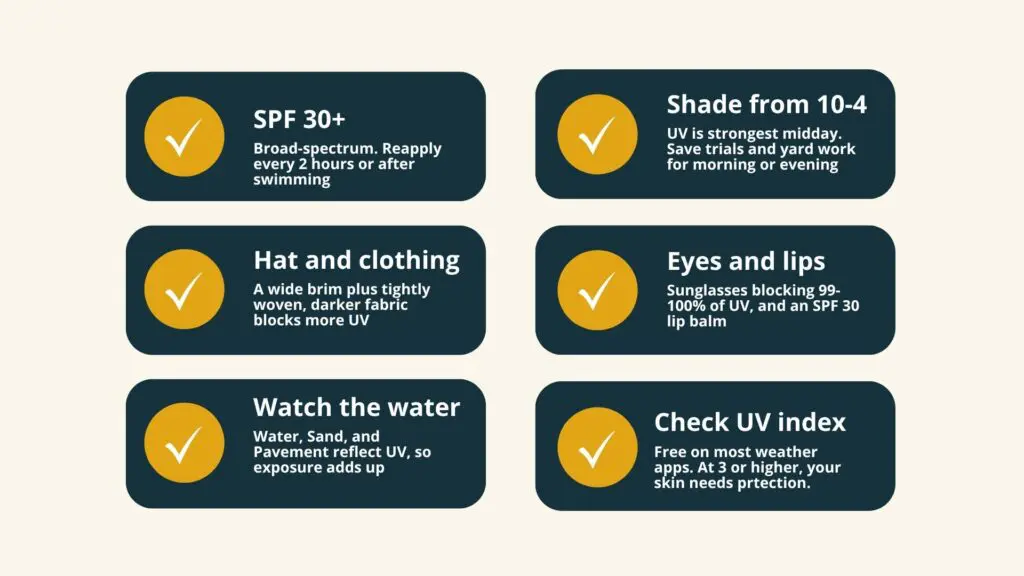
- Choose a broad-spectrum sunscreen of SPF 30 or higher. Apply it about 20 minutes before heading out, and reapply every two hours, or sooner if you are swimming or sweating.
- Time your hours outside. Ultraviolet rays are strongest from 10 a.m. to 4 p.m., so try to schedule trail time, fishing trips, and yard work for early morning or evening, when UV levels drop.
- Cover up. A wide-brimmed hat and a long-sleeved shirt go a long way, and tightly woven, darker fabrics block more UV than thin, light-colored ones.
- Protect your eyes. Pick sunglasses that block 99 to 100 percent of UVA and UVB rays, since your eyes can burn too.
- Do not skip your lips. Lip skin rarely has protective pigment, so a lip balm with SPF 30 belongs in your routine.
- Respect reflective surfaces. Water, sand, and concrete all reflect ultraviolet rays, so a day on the lake brings exposure from above and below.
- Check the UV index first. It is free on most weather apps, and it tells you exactly how careful to be.
- Know your medications. Several common ones, including certain antibiotics like doxycycline, some diuretics, and even ibuprofen, can make your skin burn faster, so ask your pharmacist or care team if you are unsure.
- Mind the windows. Windshields block most ultraviolet light, but side windows often let UVA through, so sunscreen is worth it even on long drives.
None of this means staying indoors. The point is to enjoy the lakes and trails without paying for it later.
When should you have a spot on your skin examined?

Most moles, freckles, and spots are completely harmless, but it is worth a closer look when one of them starts to change. Dermatologists use a simple memory tool called the ABCDEs:
- A is for Asymmetry: one half does not match the other.
- B is for Border: edges that look uneven, ragged, or blurred.
- C is for Color: more than one shade, or a color that shifts over time.
- D is for Diameter: anything larger than a pencil eraser, about 6 millimeters across.
- E is for Evolving: any spot that changes in size, shape, or color, or one that itches, bleeds, or will not heal.
If you notice any of these changes, there is no reason to lose sleep over it, and no reason to drive downstate. A skin check is quick, and most visits end with simple reassurance. If a spot does need attention, your care team can take the next step with you, close to home.
What about heat exhaustion and heat stroke?
Long hours in the sun gradually raise your body temperature, and on a hot afternoon that can build into heat exhaustion or, in more serious cases, heat stroke, so knowing the difference helps you act fast. Heat exhaustion usually shows up as heavy sweating, dizziness, headache, nausea, weakness, and cool, clammy skin; when it does, move into shade or air conditioning, sip water, and rest until you feel steady. Heat stroke is the more serious version and counts as a medical emergency, with signs that include a high body temperature, confusion, a rapid pulse, hot skin, and fainting. If you see these, call 911 right away and move the person to a cooler spot, because quick action makes a real difference.
Skin checks and dermatology, close to home
You should not have to drive for hours just to have your skin checked. Helen Newberry Joy Hospital offers dermatology and specialty care with Jonathan Hayward, of Lily Dermatology, right here in Newberry. Jonathan brings more than 19 years of experience in medical dermatology and has performed tens of thousands of skin cancer screenings. He treats a wide range of skin, hair, and nail conditions, including acne, eczema, psoriasis, rosacea, warts, and moles, for patients of every age, and our community knows him for care that is both thorough and genuinely kind.
Whether you want a routine skin check or help with an ongoing condition, you can be seen close to home. If a spot ever needs to be removed, minor procedures and surgical services are available locally too, so your care stays in one place with a team that already knows you.
Whenever you are ready, we are here. Schedule a skin check at Helen Newberry Joy Hospital, or talk with our team about any skin concern you have noticed this summer. Care close to home, with people who know your name.